
Grand County Criminal Docket Searches
The free Colorado Judicial Branch Docket Search for Grand County lists scheduled events, and it needs at least one filter beyond the date range. Pick Grand County first. Then choose County Court, District Court, or Both. A name, attorney, division, or split case number satisfies the added-filter rule. Criminal case numbers carry a four-digit year, a class, and a sequence. Put each part in its own box rather than one long string.
The calendar works well for confirming a future setting. It shows twenty results per page, with export and printable views. What it will not do is open a full filing history. When you need the charge history, minute orders, or the final result, request the Register of Action from the Grand County Clerk of Court. The clerk can also provide a Complaint/Information or a Disposition/Sentence Order. These are different products, so naming the exact item saves time.
- Select Grand County and the likely court type. Use Both if the filing level is not known.
- Choose a narrow date window, then add a party, attorney, division, or case-number criterion.
- Match the year, class, sequence, location, hearing type, appearance type, and courtroom.
- Widen the date range and test the other court type if no Grand County setting appears.
- Ask the clerk for the ROA or named document when the calendar cannot answer the question.
Phone, counter, mail, form, and email routes all work too. The clerk counter sits at 307 Moffat Avenue in Hot Sulphur Springs. Mail goes to P.O. Box 192, Hot Sulphur Springs, CO 80451. Call 970-725-3357, or send records requests to GrandRecordsRequest@judicial.state.co.us. The clerk posts no public terminal, so phone ahead before counting on one.
Grand County Criminal Case Classes
Case class is the first strong clue about venue. A District Court felony carries CR. A County Court misdemeanor carries M. County Court can also hold a felony complaint during its preliminary phase, before a filed or bound-over felony moves up to District Court. Traffic classes are T and R. JD marks a juvenile class with restricted public access. These codes keep a docket search from running against the wrong court.
| Class | Grand County court | Typical use |
|---|---|---|
| 2026CR... | District Court | Filed felony case |
| 2026M... | County Court | Misdemeanor case |
| 2026T... or R | County Court | State traffic matter |
| JD | District Court | Restricted juvenile matter |
Grand County Court and Grand County District Court share the Grand County Judicial Center. They also share one Clerk of Court. Sharing a counter does not merge their jurisdiction. A municipal charge may stay in that town's own court. That applies to Granby, Fraser, Winter Park, Kremmling, or Hot Sulphur Springs. Read the citation or charging paper before assuming it belongs in the state docket search.
Criminal Dockets: What They Show
What the public sees in a Grand County result is a setting record. It can confirm when and where a hearing is planned. The official record request form defines a Register of Action as a brief case explanation that can include charges, sentences, and minute orders. The free calendar itself publishes no full Grand County ROA sample. So do not assume fields like bond, plea, lawyer, balance, or document links from it.
| Date and Time | The scheduled start information for the listed event. |
|---|---|
| Duration | Calendar time set aside, not a promise of when the event will end. |
| Case Number | Year, class, and sequence, such as 2026CR.... |
| Hearing Type | A scheduling label such as Advisement, PreTrial Conference, or Jury Trial. |
| Appearance Type | IN PERSON, VIRTUAL, or TELEPHONE when shown. |
| Location and Courtroom | The court site and room tied to the setting. |
A setting is not an outcome. A Plea Sentencing Hearing on the calendar means that function was scheduled. It does not prove a plea was entered or a sentence imposed. For the actual result, trust the signed Disposition/Sentence Order. A certified clerk record is equally sound.
Grand County Criminal Record Layers
Three record layers answer three different questions. The free docket answers when a Grand County hearing is set. The ROA supplies a chronological summary. The actual complaint, information, minute order, or sentence order supplies the text behind an event, and a certified copy adds the Clerk of Court's authentication for formal use.
The Colorado Judicial Branch links to a fee-based real-time ROA vendor. It warns, though, that vendor results are not the official record, may omit cases, and do not provide document copies. Treat that source as orientation only. For an official Grand County criminal record, submit the Judicial Record or Document Request, visit the clerk, call, mail the request, or use the Grand records email. Ordinary requests are expected within three business days unless special circumstances require more time.
Copies cost $0.25 per page. A certified or exemplified copy runs $20 per document, plus applicable copying. A name search is $5. Older off-site files may add actual retrieval cost, and research or redaction can cost $30 per hour in fifteen-minute units after the first hour.
Criminal Case Stages on the Docket
A criminal case can move through a complaint or information, advisement or arraignment, bond proceedings, pretrial work, motions, plea or trial, disposition, and sentence. Appeal can follow. Those steps describe the usual lifecycle. They do not mean Grand County uses one fixed label for every stage. The calendar itself tells you what to expect. Its settings include Appearance on Bond, Hearing on Advisement, PreTrial Conference, Plea Sentencing Hearing, Disposition Hearing, and Jury Trial.
Docket flow: Filing › Arraignment › Pretrial › Plea or Trial › Disposition › Sentencing
The free docket is strongest at the setting stage. It may show what is planned next, but it has no direct filing-history link. Request the ROA to trace the sequence. Then request the actual paper for any entry whose exact language matters. A saved printout and the live Grand County calendar can differ. If they ever do, check with the clerk before attending.
Grand County Criminal Bond Records
Bond questions in Grand County can land in two different offices. Someone in custody may need the current bond type or amount. Call the Grand County Sheriff's detention operation at 970-725-3343. Getting bond money back is a court matter instead. Route those calls to the court at 970-725-3357. Remember that neither office replaces the criminal ROA. A jail charge is not a clerk copy fee.
The Grand County detention page posts the jail's bond and booking contacts.
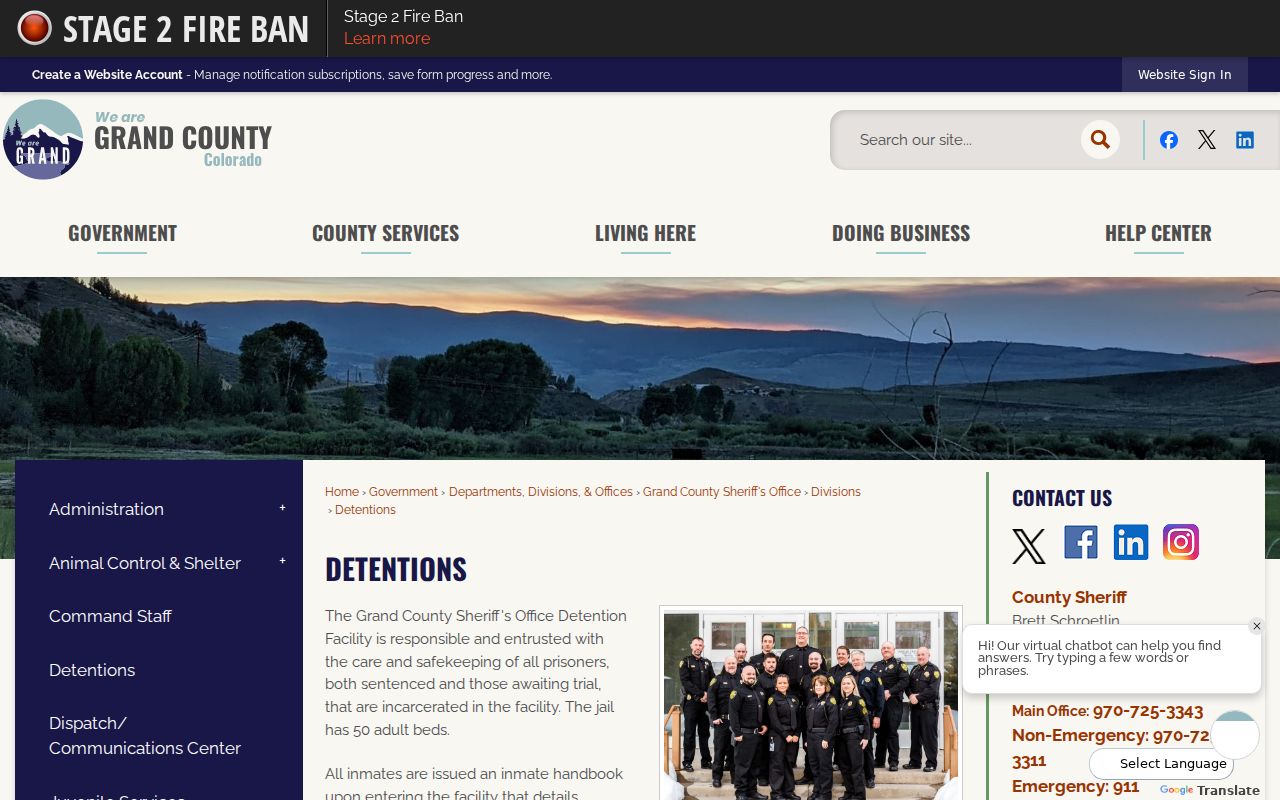
The split is simple once you see it. Detention staff field current custody details. The Grand County Clerk of Court keeps the court case record. The Sheriff lists a $10 cash-only filing charge per bond plus a $30 booking fee. Those sums are not docket access or certification prices. Ask the right office for the right item.
Grand County Criminal Docket Courts
Grand County District Court is the general-jurisdiction court where felony cases are filed. Grand County Court handles misdemeanors, state traffic matters, and protection orders. Certain felony complaints start there too. Both sit in the Fourteenth Judicial District alongside Moffat and Routt Counties. District staff may cover more than one county. Even so, the Grand County Clerk of Court keeps the Grand files.
Town courts add a separate layer. They hear local ordinance and municipal traffic matters. A town charge can stay outside the Combined Court system until an appeal. County Court judgments generally appeal to District Court. District Court rulings usually go higher. They go to the Colorado Court of Appeals. Municipal appeal routes turn on whether the town court is a qualified court of record. Never assume that status without confirmation.
Do not send a criminal records request to the elected Grand County Clerk and Recorder. That office sits at 308 Byers Avenue. It holds land, election, motor vehicle, vital, and other county records. Criminal court requests belong with the Judicial Branch clerk at 307 Moffat Avenue.
Grand County Criminal Reset Checks
The free calendar does not display reset history, and the Export and Printable Version options save only a working snapshot of the court docket. Once a continuance is entered, run the docket search again with the same case details and a current date range. If the live result stays unclear or travel is imminent, call 970-725-3357 ext. 7.
- Continuance or Reset
- A hearing moved to another date; the public result does not show the full history of that move.
- Duration
- The block of court time assigned to the event, not its guaranteed length.
- Appearance Type
- The listed in-person, virtual, or telephone mode. A remote label is not permission by itself.
- Minute Order
- A brief court record of action taken, available through the official record route when public.
Mountain travel in Grand County and temporary clerk-hour notices both argue for a final check. Look at the court landing page for closure or service notices before you leave. When the docket reads VIRTUAL or TELEPHONE, get court-approved connection details, because a public stream does not count as an appearance.
Access Rules for Criminal Dockets
Access rules for criminal dockets start with Colorado's CJD 05-01 Public Access to Court Records. That rule sets security levels for court records. Criminal justice records also involve C.R.S. sections 24-72-304 and 24-72-305. The custodian may apply rules, redaction, statutes, and court orders. The public-interest standard also applies. Remote-access redaction covers Social Security, account, passport, tax, student, and personal identification numbers.
Grand County access rule: Public does not mean every case or every field is online.
Juvenile, sealed, suppressed, restricted, and other confidential records may be absent or limited. Never try to bypass an identity gate or court access control.
Protected material can become public after the required redaction. Restricted material stays limited to parties, lawyers, the court, and authorized agencies. Suppressed and sealed records face tighter access still. A missing docket result can also mean the date window is wrong, the case sits in municipal court, or a vendor omitted it. Absence alone does not establish that no case exists.
Grand County Criminal Sealed Checks
Colorado's sealed-case tool lets a defendant verify one qualifying conviction. That conviction may have been sealed automatically. It is identity-gated. It is not a public name search. The form asks for court location, year, class, sequence, name, and date of birth. It also needs a driver license number or Social Security number. It demands a declaration under penalty of false swearing.
The official Sealed Case Search lays out that narrow verification route.
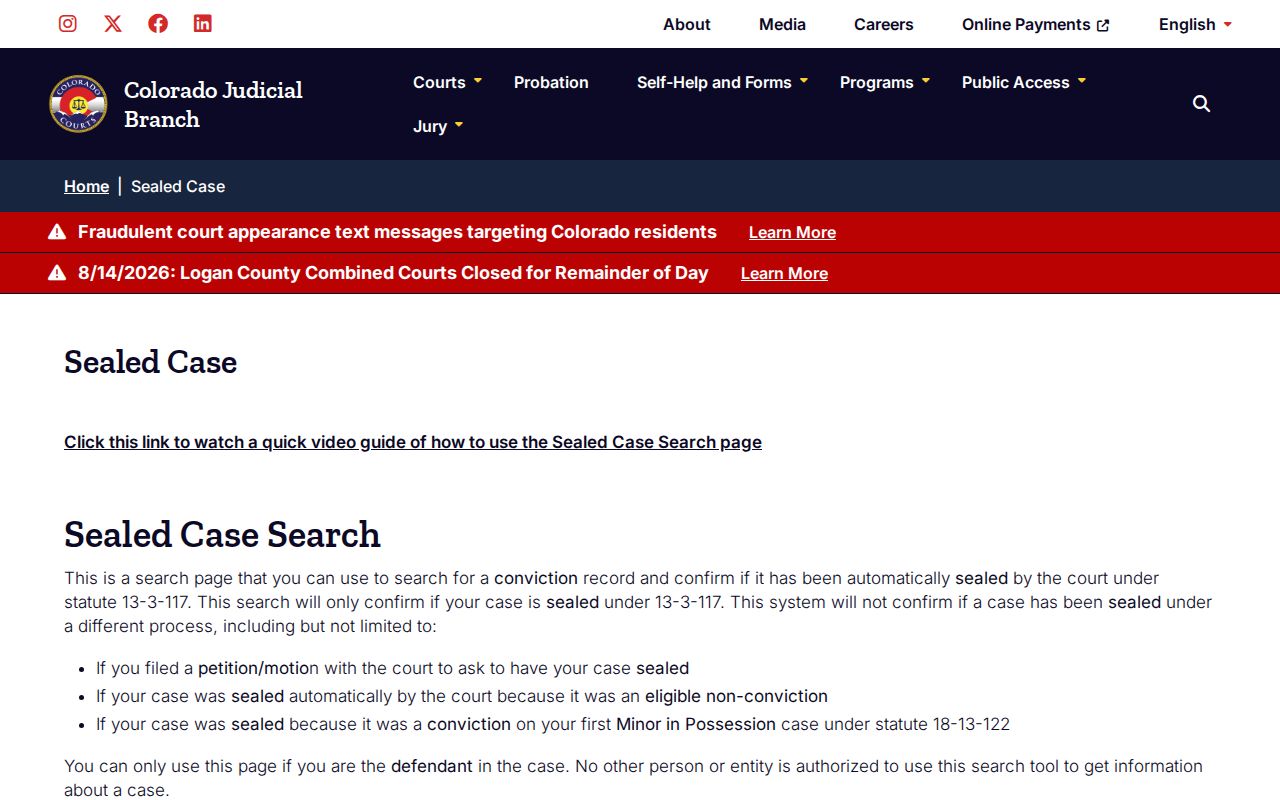
That limited check should never be confused with a public Grand County docket search. They are different tools for different people.
Petition-based sealing falls outside the single-case check. So do automatically sealed nonconvictions. A first minor-in-possession matter falls outside it as well. Colorado offers separate form groups for conviction sealing and municipal conviction sealing. Others cover multi-case sealing, nonconvictions, and juvenile expungement. Eligibility depends on the record and the governing law.