
Grand County Civil Docket Searches
Start at the Grand County Docket Search. County Court handles most C, S, and eviction matters in Grand County. District Court covers CV, DR, PR, and CW cases. Unsure which level holds your civil docket? Pick Both. The tool will not run on dates alone. So enter a name, a business, a lawyer, a division, or a case number alongside the range.
A case number spans three fields: the four-digit year, the class, and the sequence. What you get back is a setting, not the pleadings or the full register. Export and Printable Version make handy working copies of a Grand County court docket. Neither is a certified record. If nothing comes up, widen the date range, try the other court level, and recheck the case class. Some matters simply have no hearing in the window you chose, and others are restricted from view.
- Select Grand County and the likely court type.
- Choose the narrowest useful date window.
- Add party, business, attorney, division, or split case number.
- Check case number, hearing type, location, appearance type, and courtroom.
- Request the ROA or actual paper from the clerk if the calendar is not enough.
You can also reach the clerk at the counter at 307 Moffat Avenue, by phone at 970-725-3357, by mail to P.O. Box 192, through the statewide request form, or by email to GrandRecordsRequest@judicial.state.co.us. The office posts no confirmation of a lobby terminal. Call ahead before planning on one.
Grand County Civil Case Classes
Class codes tell you where a Grand County civil docket actually lives. County Court class C covers limited civil matters. It shares jurisdiction with District Court for claims below $25,000. Class S is small claims, capped at $7,500. District Court class CV handles general civil suits with no County Court dollar limit. Beyond those, DR marks domestic relations, PR is probate, and CW signals a water case. Knowing the code saves you a dead-end docket search.
| Class | Court | Grand County matter |
|---|---|---|
| C | County Court | Limited civil, including many money and eviction cases |
| S | County Court | Small claims up to $7,500 |
| CV | District Court | General civil litigation |
| DR | District Court | Domestic relations |
| PR | District Court | Probate and guardianship |
| CW | District or Water Court | Water case |
Municipal courts do not hear private contract, property, injury, family, or felony disputes. A town court keeps only its own ordinance docket. Sharing one Grand County building does not blur the line between County Court and District Court case classes.
Civil Dockets: What They Show
The free Grand County civil calendar lists date, time, duration, caption or name label, case number, hearing type, location, appearance type, and courtroom. Typical labels include Show Cause, NonContested Hearing, Motion to Modify, Dissolution Permanent Orders, Guardianship Hearing, and Status Conference. Each one names a planned event and nothing more. The label does not disclose the motion behind it or any signed ruling.
| Case Number | Year, class, and sequence, such as 2026CV.... |
|---|---|
| Caption | The case-style or name label used on the setting. |
| Hearing Type | The court's scheduling label, not the result. |
| Duration | Time allocated on the calendar, not guaranteed length. |
| Appearance Type | IN PERSON, VIRTUAL, or TELEPHONE when listed. |
| Courtroom | The room tied to the event. |
Behind that calendar view sits the ROA, the chronological index of every entry in the case. A complaint, motion, order, or judgment remains a separate filed document. When exact wording matters, request the paper itself.
Grand County Civil Filing Counts
Official FY2024 figures offer scale without describing any single pending case. Grand County Court logged 152 civil filings: 31 FED matters, 69 money cases, 3 name changes, 5 other matters, 33 replevin filings, and 11 civil protection orders. Grand County District Court added 175 civil filings of its own.
Treat these strictly as filing totals. They are not counts of people, open cases, judgments, or online search results. One case can generate many calendar rows, so a one-week Grand County civil docket is never a caseload measure.
What Cases Fill the Civil Docket
Money claims, evictions, replevin, name changes, protection orders, contract and property disputes, domestic relations, probate, guardianship, and water matters all fill the Grand County civil dockets. The class and court level tell you more than the fact that every state file starts at one shared clerk counter. Small-claims summons returns happen in person on Wednesdays. Civil return papers are accepted during open clerk blocks. A typical civil case moves through complaint or petition, service, answer, motions, settings, trial or a dispositive order, judgment, enforcement, and appeal. Those stages are explanatory only, not verified Grand County ROA labels. The calendar finds a hearing. The ROA traces events. The filed paper holds the full text.
Grand County Judgment Record Choices
The official request form separates several civil products. An Order for Judgment records the court's decision itself. A Transcript of Judgment is a clerk-issued judgment record costing $25. It is not an audio or verbatim transcript of anything said in court. A Certificate of Satisfaction costs $20 and records that a judgment was satisfied. Certification or exemplification runs $20 per document plus copy charges. Submit the Colorado Judicial record request form with the year, class, sequence, county, parties, and the exact item you need. Plain copies cost $0.25 per page, and a name search is $5. Older files may carry actual off-site retrieval costs. Research or redaction work past the first hour bills at $30 per hour in fifteen-minute units. A plain copy suits ordinary reading. A certified copy adds clerk authentication. Spoken-proceeding transcripts go through a separate transcript request channel. Digital recordings are not available in the Fourteenth District under the cited chief judge order.
Hearings on the Civil Docket
Setting lines on a Grand County civil docket are calendar entries, not verdicts. Show Cause means a party must answer for compliance. Status Conference is case-management talk. Guardianship Hearing and Dissolution Permanent Orders tell you the subject and the stage, nothing more. The label does not prove the judge ruled. It does not prove the judge ruled one way or the other, whatever it says. Check the date, time, appearance type, court location, and courtroom before you go. A VIRTUAL or TELEPHONE tag grants no automatic permission, so get court-approved connection details. The portal shows no reset history. A saved printout can go stale after a continuance. Run the docket search again, and call 970-725-3357 ext. 7 if anything conflicts.
Grand County Sheriff Service Costs
Serving papers is common in civil cases, but the Sheriff's service fee is not a fee for the court file. The Grand County Sheriff Civil Division page lists the service routes and what each one charges.
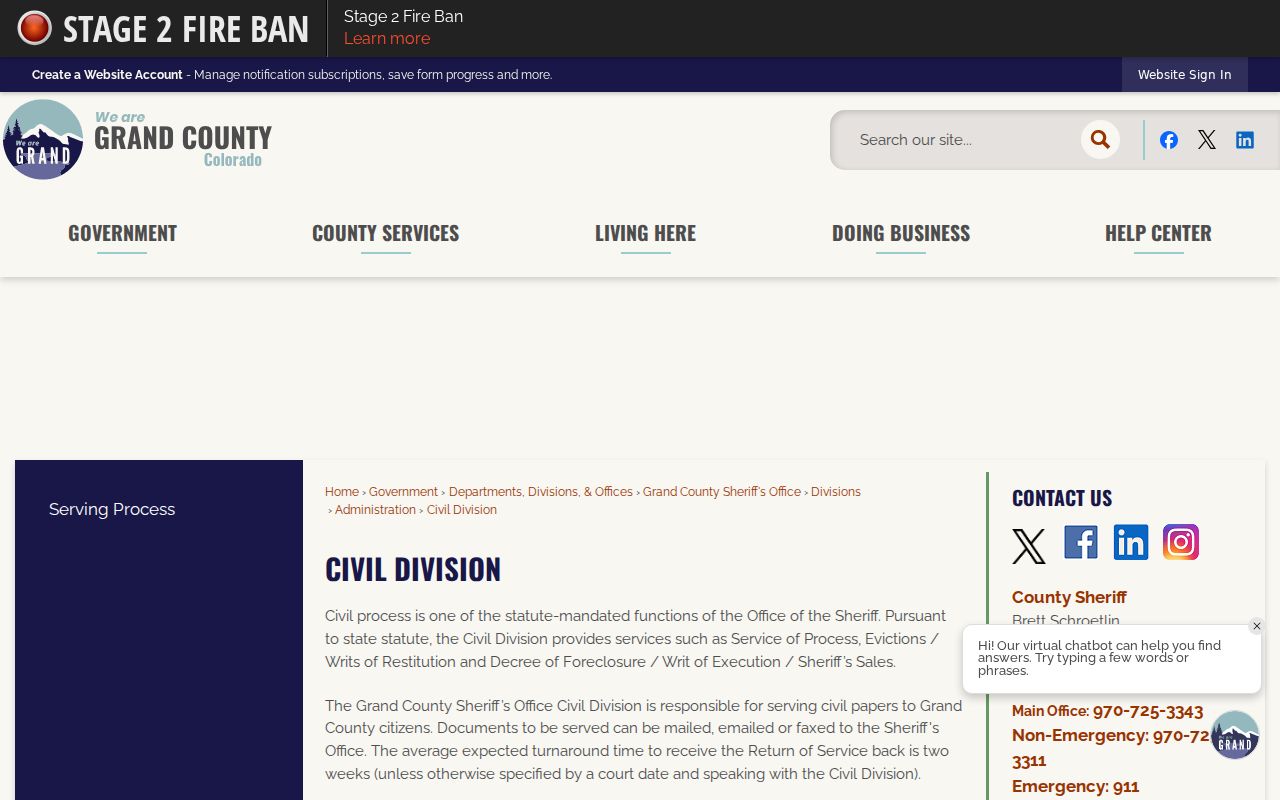
Sheriff service and clerk paperwork are two different bills. The Grand County Sheriff charges for handing papers to the other side, while the Clerk of Court handles copy and certification fees for the court record itself.
The sheriff's fee schedule lists the going rates. Service of a demand or possession notice runs $35. A notice, claim, summons, or summons and complaint also costs $35. Civil subpoenas and restitution services are each $60, and paying $25 more buys a rush job finished within seven days.
None of that covers the docket itself. Copies of the Grand County civil docket, the ROA, and anything else filed with the court still come from the judicial clerk.
Who Can See Civil Dockets
CJD 05-01 sets the rules for public access to Colorado court records. Even public files can be limited by redaction, statute, rule, or court order. Protected papers may open up once the required redactions are made. Restricted, suppressed, and sealed records face tighter controls. Domestic, juvenile, probate, mental-health, adoption, and other sensitive matters can call for a special access review. Some cases may also require photo identification before the clerk releases anything.
Grand County access point: A missing civil result does not prove no case exists.
The date range, court type, case class, access level, or lack of a current setting can all explain an empty calendar search.
The Colorado Open Records Act overview covers public records in general. For court case files, though, it is not the default route.
Here is the line that matters. Court case documents go through judicial rules and the Branch request process, not the county's general CORA form.
Grand County Administrative Record Rules
Judicial administrative records and case records are two different things. Colorado Supreme Court Chapter 38, PAIRR Rule 2 governs Judicial Branch administrative records. It does not replace CJD 05-01 for the merits papers filed in a civil case. The PAIRR Rule 2 change page names the administrative-record rule in force. Administrative records sit apart from case files. That split matters when you request court records from Grand County.
Figure out which rule applies first. Then ask the Grand County Clerk of Court for a civil case paper. For the case itself, request the ROA or a named filing. For Judicial Branch administration, use the PAIRR route. For county-government records unrelated to a court case, CORA may apply. The elected County Clerk and Recorder at 308 Byers Avenue keeps land, election, and vehicle records. That office does not hold Grand County Court or District Court dockets.
Grand County Civil File Requests
A calendar search can land you on the right Grand County case. It may still leave the paper you need out of reach. The official request form lets you name it. Choose a divorce decree, parenting plan, separation agreement, support order, complaint, petition, protection order, judgment, satisfaction, probate paper, or Register of Action. Give the full year, class, sequence, location, and party details when you know them. That detail helps the clerk tell a C case from CV, S, DR, PR, or CW.
Protected, restricted, suppressed, sealed, juvenile, and some probate requests may require photo identification. Others may require proof of authority. The normal response target is three business days unless special conditions justify more time. Payment instructions may follow an estimate. An old Grand County civil file can carry off-site retrieval costs. Name the precise record and year rather than every paper in the case.
The Grand County Clerk of Court is the judicial custodian. The elected County Clerk and Recorder handles land, election, vehicle, vital, and other county records. It does not hold the County Court or District Court civil docket.